
What Is Ultrasound-Guided Aesthetics? A Complete Patient Guide
Ultrasound is changing the way some aesthetic treatments are assessed, planned and performed. Instead of relying only on visible anatomy and touch, a suitably trained practitioner can use high-frequency ultrasound to view structures beneath the skin in real time.
This can provide valuable information about facial anatomy, blood vessels, tissue layers and previously placed filler. It may also help a practitioner investigate certain concerns or complications and deliver treatment more precisely.
But what does ultrasound-guided aesthetics actually involve, and what should you expect as a patient? This guide explains the essentials.
What is ultrasound-guided aesthetics?
Ultrasound-guided aesthetics is the use of diagnostic ultrasound imaging within non-surgical aesthetic practice.
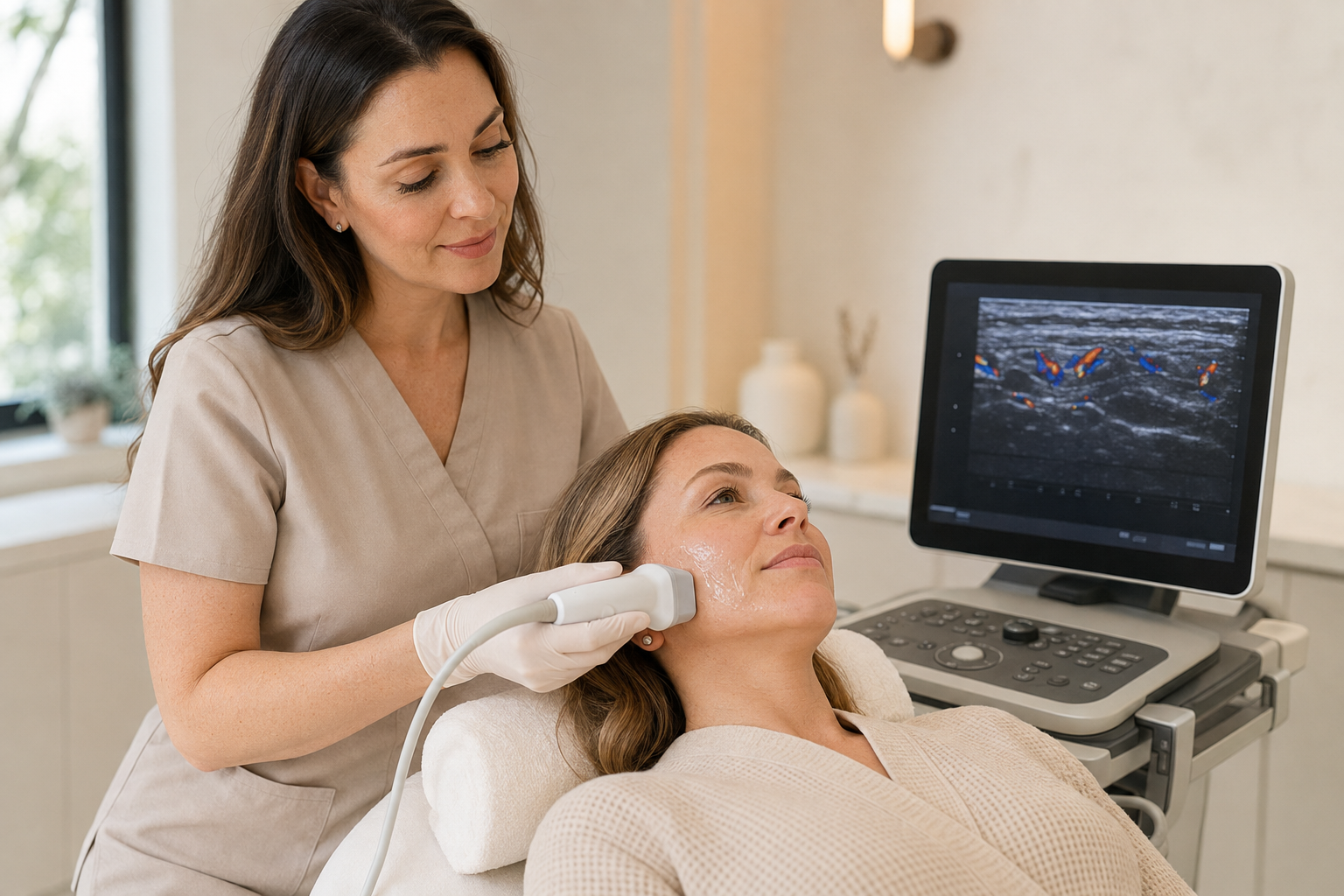
A small handheld probe, called a transducer, is placed against the skin with a layer of ultrasound gel. The device sends sound waves into the tissues and converts the returning echoes into an image on a screen. This allows the practitioner to examine structures beneath the surface without surgery or radiation.
Depending on the device and clinical purpose, ultrasound may help visualise:
- The different layers of the skin and underlying soft tissue
- Muscles and fascia
- Blood vessels, sometimes using colour Doppler to assess blood flow
- Existing dermal filler deposits
- Areas of swelling, nodules or other concerns
- The position and depth of a needle or cannula during selected procedures
It is important to understand that this is diagnostic ultrasound, used for imaging. It is not the same as HIFU, which uses focused ultrasound energy to heat targeted tissue as an aesthetic treatment.
Why is ultrasound used in aesthetics?
Every face is anatomically different. Although practitioners study recognised patterns of facial anatomy, the exact position and depth of a vessel can vary from one person to another. Previous surgery, scarring, trauma and aesthetic treatments may also alter what lies beneath the skin.
Ultrasound can add patient-specific information to the consultation and treatment plan. Rather than depending entirely on surface landmarks, medical history and palpation, the practitioner may be able to see relevant anatomy directly.
Research reviews suggest that high-frequency ultrasound can support the identification of facial structures, mapping of vessels, localisation of filler and assessment of filler-related complications. However, it is an additional clinical tool—not a substitute for medical knowledge, appropriate training, careful technique or emergency preparedness.
When might ultrasound be helpful?
Before treatment
A practitioner may scan an area before an injectable procedure to understand the tissue layers, identify significant vessels or check for existing filler.
This can be particularly helpful when:
- You have had filler previously but do not know exactly where or what was injected
- The treatment area has complex anatomy
- There is scar tissue or altered anatomy
- The practitioner needs more information before deciding whether treatment is appropriate
- A personalised vessel map may help with treatment planning
A scan can sometimes lead to a change in the proposed treatment—or a decision not to treat. That is a positive sign of careful clinical judgement.
During treatment
In selected cases, the practitioner may use real-time ultrasound to guide the position of a needle or cannula. This may help confirm the intended tissue plane and show the relationship between the instrument and nearby structures.
Not every injection is performed under continuous ultrasound guidance. The way ultrasound is used will depend on the treatment, the area, the equipment and the practitioner’s training.
After treatment or when investigating a concern
Ultrasound may help locate existing filler and assess concerns such as:
- A lump or nodule
- Persistent swelling
- Asymmetry
- Suspected filler migration or incorrect placement
- An unexpected result after a previous procedure
- A possible vascular complication
If hyaluronic acid filler needs to be dissolved, ultrasound may help a qualified prescriber or practitioner locate the product and guide hyaluronidase towards the relevant area. Hyaluronidase is a prescription-only medicine in the UK and its use for dissolving cosmetic hyaluronic acid filler is generally off-label, so an individual clinical assessment and informed consent are essential.
Does ultrasound make aesthetic treatment completely safe?
No aesthetic injection is completely risk-free, and ultrasound should never be presented as a guarantee of safety.
Ultrasound can provide additional visual information and may support more accurate planning or guidance. However, image quality, facial movement, the limitations of the equipment and the practitioner’s ability to acquire and interpret images all matter. Small structures can be difficult to identify, and anatomy may change as a needle, cannula or product moves through tissue.
Safe practice still depends on:
- A thorough medical consultation
- Detailed anatomical knowledge
- Appropriate professional qualifications and ultrasound training
- Careful product selection and injection technique
- Informed consent
- Recognition and management of complications
- Suitable emergency medicines, protocols and referral pathways
Think of ultrasound as an extra layer of clinical information—not a replacement for expertise.
What happens during an ultrasound assessment?
Your appointment should begin with a consultation. The practitioner may ask about your medical history, medications, allergies, previous procedures and the results you hope to achieve.
For the scan, you will usually be positioned comfortably while a clear gel is applied to the skin. The practitioner moves the probe gently over the treatment area while viewing the images on a screen. They may use colour Doppler settings to examine blood flow.
The examination is non-invasive and generally painless, although light pressure from the probe may feel tender if an area is already swollen or sore. A straightforward scan may take only a few minutes, while a detailed assessment or ultrasound-guided procedure may take longer.
Depending on the findings, the practitioner may proceed with the planned treatment, adapt the technique, recommend further assessment or decide that treatment should be postponed.
Is there any downtime from the scan?
The ultrasound scan itself does not normally require downtime. The gel is wiped away afterwards, and you can usually return to normal activities immediately.
If the scan is combined with an injectable treatment, any redness, swelling, tenderness, bruising or downtime will relate mainly to that procedure rather than to the ultrasound imaging. Your practitioner should explain the expected effects and provide appropriate aftercare.
Who should perform ultrasound-guided aesthetic procedures?
Ultrasound is highly operator-dependent: owning an ultrasound device is not the same as being competent to use it.
Look for a practitioner who:
- Is appropriately qualified and works within their professional scope
- Has specific education and supervised practical training in facial ultrasound
- Understands facial anatomy, injectable treatments and complication management
- Can explain what the scan can and cannot show
- Uses an appropriate high-frequency device and follows infection-control procedures
- Keeps clear clinical records and has suitable follow-up and referral arrangements
You should feel comfortable asking how frequently the practitioner uses ultrasound and what training they have completed.
Questions to ask at your consultation
You may wish to ask:
- Why are you recommending ultrasound in my case?
- Will it be used before treatment, during treatment or both?
- What are you looking for on the scan?
- Could the findings change the treatment plan?
- What training and experience do you have in facial ultrasound?
- What are the risks and alternatives to the proposed procedure?
- What happens if you find existing filler or an unexpected feature?
- What aftercare and emergency support are available?
A responsible practitioner should welcome these questions and explain the plan in language you understand.
What are the key benefits for patients?
When clinically appropriate and performed by a suitably trained practitioner, ultrasound may offer:
- A more individualised assessment of facial anatomy
- Better information about the location and depth of existing filler
- Support when planning injections around visible vascular structures
- Real-time guidance in selected procedures
- More targeted investigation of lumps, swelling or other concerns
- Clearer clinical decision-making, including when not to proceed
The main benefit is not simply having advanced technology in the room. It is using the information responsibly to make a more considered treatment decision.
The bottom line
Ultrasound-guided aesthetics brings real-time imaging into the consultation and treatment process. It can help a trained practitioner look beneath the skin, assess previous filler, identify relevant anatomy and guide selected interventions with greater information.
It is a valuable development in evidence-informed aesthetic practice, but it does not eliminate risk. The quality of the assessment depends heavily on the practitioner’s qualifications, ultrasound training, judgement and ability to manage complications.
If you are considering an ultrasound-assisted aesthetic treatment, book a full consultation and ask why imaging is being recommended for you. Your treatment plan should always be based on your anatomy, medical history, previous procedures and individual goals.
This article provides general information only and does not replace personalised medical advice, diagnosis or treatment. If you develop severe or increasing pain, unusual skin colour changes, visual disturbance or other worrying symptoms following an aesthetic injection, seek urgent medical assessment.
Sources and further reading
- The role of ultrasound in facial hyaluronic acid dermal filler procedures: A systematic review
- Ultrasound in Aesthetics: Filler and Non-Filler Applications
- Best Practices for the Use of High-Frequency Ultrasound in Aesthetic Medicine
- Doppler Ultrasound in the Management of Vascular Complications Caused by Hyaluronic Acid Fillers
- ACE Group World: The Use of Hyaluronidase in Aesthetic Practice
Ready to take the next step?
Would you like to know whether ultrasound assessment could be useful as part of your aesthetic treatment plan? Book a consultation with Pretty Skin Prescriptions to discuss your previous treatments, concerns and goals.

