By Pretty Skin Prescriptions
Can HIFU Really Lift Sagging Skin? Setting Realistic Expectations
By Pretty Skin Prescriptions
Editor’s Note: Throughout this article, the superscript numbers (¹,²,³ etc.) correspond to the scientific references listed at the end of the article. On our website, these will be hyperlinked so you can click each citation to view the supporting evidence.
Ageing is a privilege, but it often brings changes to our skin that many of us would like to improve. One of the most common questions we are asked at Pretty Skin Prescriptions is:
“Can HIFU really lift sagging skin?”
The answer is **yes—but only in the right patient and with realistic expectations.**¹⁻⁶
There is a great deal of misinformation online, with some clinics advertising HIFU as a “non-surgical facelift.” Whilst High-Intensity Focused Ultrasound (HIFU) is one of the most scientifically researched non-invasive skin tightening technologies available, it is not a replacement for facelift surgery. Instead, it works by stimulating your body’s own collagen production, gradually improving skin firmness, elasticity and definition over several months.¹⁻⁶
What is HIFU?
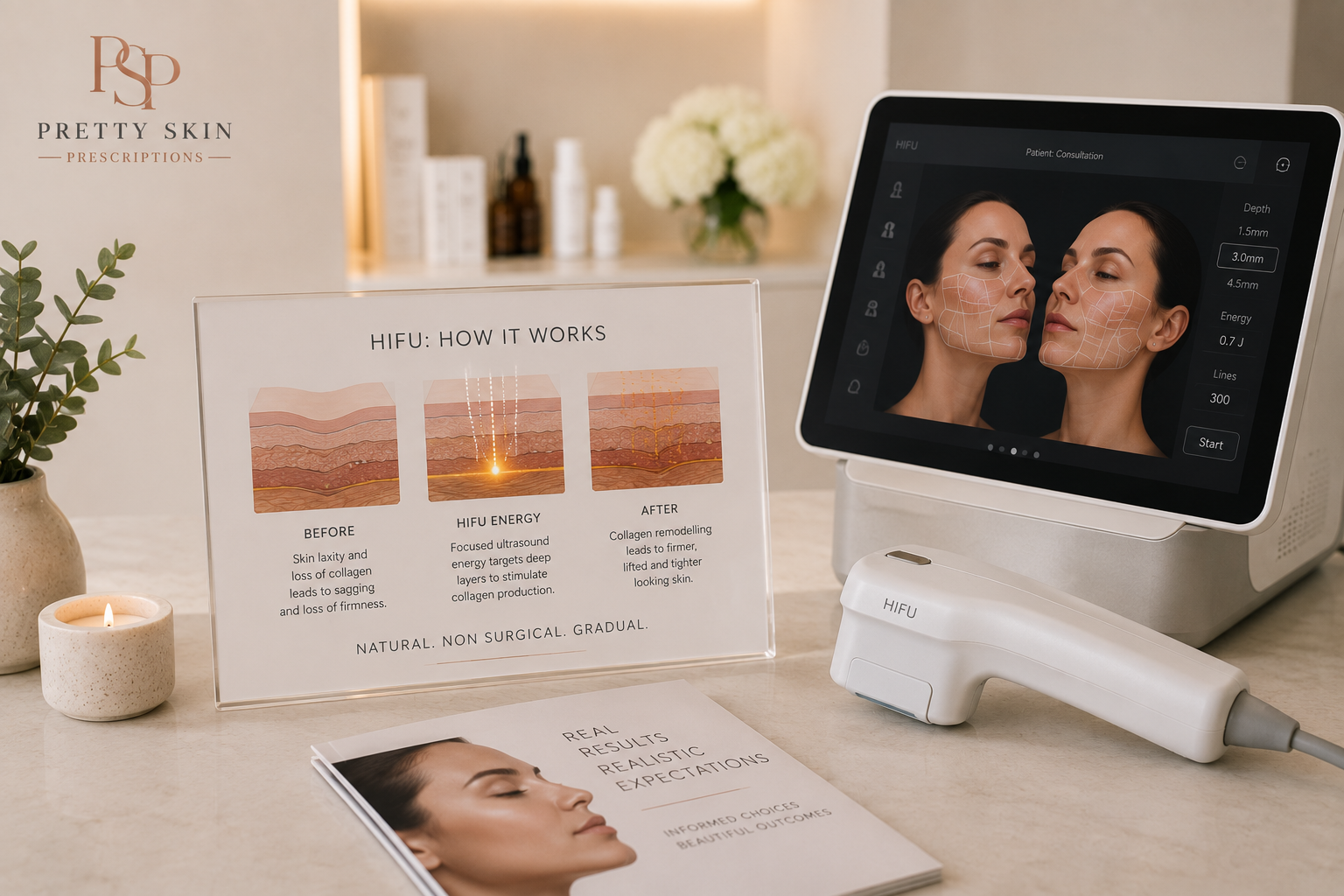
High-Intensity Focused Ultrasound (HIFU), also known as microfocused ultrasound (MFU), delivers focused ultrasound energy to precise depths beneath the skin whilst leaving the skin surface completely intact.¹²
Unlike lasers, which primarily target superficial layers of the skin, HIFU penetrates deeper tissues, including the Superficial Musculoaponeurotic System (SMAS)—the same structural layer tightened during a surgical facelift.¹²
The ultrasound energy generates tiny thermal coagulation points at approximately 60–70°C, creating a controlled wound-healing response that stimulates fibroblasts to produce new collagen, elastin and extracellular matrix proteins.¹³⁻⁶
This process is known as neocollagenesis, meaning your body gradually rebuilds its own supportive collagen network rather than relying on artificial implants or fillers.¹⁴
Why Does Skin Start to Sag?
Skin laxity is caused by a combination of biological ageing and environmental damage rather than one single factor.⁷⁻⁹
From our mid-twenties onwards, collagen production naturally declines by approximately 1% each year, whilst elastin fibres become weaker and fragmented.⁷⁻⁹
Other contributing factors include:
- Ultraviolet (UV) exposure and photoageing⁷
- Smoking⁷
- Hormonal changes, particularly following menopause⁸
- Gradual loss and descent of facial fat pads⁸
- Changes in facial bone structure with age⁸
- Genetics
- Repeated facial movement over many years
These changes reduce the skin’s structural support, allowing gravity to gradually soften the jawline, cheeks and neck.⁷⁻⁹
How Does HIFU Lift the Skin?
The word “lift” can sometimes create unrealistic expectations.
HIFU does not physically pull loose skin upwards like surgery.¹⁻⁶
Instead, it stimulates your own collagen-producing cells to remodel and strengthen existing support structures beneath the skin.¹³⁻⁶
Over approximately 8–16 weeks, newly formed collagen gradually contracts and tightens the tissue, leading to improvements in:
- Jawline definition³⁻⁵
- Mild jowls³⁻⁵
- Neck laxity³⁻⁵
- Brow position²
- Overall skin firmness¹⁻⁶
- Skin texture and quality¹⁴
Results develop gradually, which often creates a very natural appearance.
Who Is the Best Candidate?
Scientific evidence consistently shows the best outcomes occur in patients with mild to moderate skin laxity.¹³⁻⁶
You may be an excellent candidate if you:
 Have mild skin looseness
Notice early jowl formation
Want natural-looking improvements
Prefer a non-surgical treatment
Understand that collagen takes time to rebuild
Patients with significant excess skin or advanced facial ageing may benefit more from surgical intervention, as HIFU cannot remove redundant skin.³⁻⁶
How Much Lift Can You Realistically Expect?
This is the most important question.
For carefully selected patients, HIFU can produce visible improvements in facial contour, skin tightness and jawline definition.¹³⁻⁶
However, ethical practitioners should never promise dramatic lifting equivalent to surgery.
At Pretty Skin Prescriptions, we believe honest consultations are just as important as excellent treatments. If we do not believe HIFU is the right option for you, we will explain why and discuss alternative treatments that may better achieve your goals.
How Long Do Results Last?
Collagen remodelling continues for approximately 3–6 months following treatment.¹⁴
Visible improvements commonly last 12–18 months, although this varies according to age, genetics, lifestyle, smoking, sun exposure and ongoing collagen loss.¹⁵
Many patients choose annual maintenance treatments to preserve their results.
Can HIFU Be Combined With Other Treatments?
Absolutely.
Facial ageing is complex and involves much more than skin laxity alone.⁸⁹
Depending upon your individual assessment, HIFU may be combined with:
- Medical-grade skincare
- Polynucleotides
- Calcium hydroxylapatite (Radiesse®) biostimulation¹⁰
- Radiofrequency microneedling
- Anti-wrinkle injections
- Dermal fillers where clinically indicated
Combination treatment plans often produce superior long-term outcomes compared with a single treatment alone.¹⁰
Is HIFU Safe?
Current evidence demonstrates that HIFU has an excellent safety profile when performed by appropriately trained practitioners using suitable devices and treatment protocols.¹⁻⁶
Temporary redness, swelling and mild tenderness are the most frequently reported side effects and typically resolve within a few hours or days.³⁻⁶
As with any medical aesthetic treatment, a detailed consultation and suitability assessment should always be carried out before treatment.
Our Verdict
Can HIFU really lift sagging skin?
Yes—but within realistic limits.
For patients with mild to moderate skin laxity, HIFU can stimulate natural collagen production and produce gradual improvements in firmness, definition and facial contour.¹⁻⁶
It is not a replacement for facelift surgery, nor should it be presented as one.
At Pretty Skin Prescriptions, we believe in evidence-based aesthetic medicine, realistic expectations and personalised treatment plans. Our aim is never to oversell a procedure, but to recommend the treatment that is genuinely most appropriate for your skin and your long-term goals.
Frequently Asked Questions
Does HIFU hurt?
Most patients describe HIFU as causing intermittent warmth, tingling or brief “electric” sensations as the ultrasound energy is delivered. Discomfort is generally well tolerated and temporary.¹²
How many HIFU treatments will I need?
Most patients require one treatment, followed by maintenance approximately every 12–18 months depending on skin ageing and individual response.¹⁴⁻⁶
When will I see results?
Some patients notice subtle tightening within a few weeks, but the majority of collagen remodelling occurs over 8–16 weeks, with continued improvement for up to six months.¹⁴
Is HIFU better than radiofrequency?
Neither treatment is universally “better.” HIFU treats deeper structural tissues, including the SMAS, whereas radiofrequency primarily targets the dermis. Your practitioner will recommend the most appropriate treatment—or a combination of both—based on your skin concerns.⁵
Can HIFU replace a facelift?
No. HIFU can improve mild to moderate skin laxity but cannot remove excess skin or achieve the same degree of lifting as surgical facelift procedures.¹⁻⁶
Can HIFU be combined with dermal fillers?
Yes. HIFU addresses skin laxity, whilst dermal fillers restore lost volume. When clinically appropriate, combining treatments can produce a more balanced and natural facial rejuvenation.¹⁰
Who should avoid HIFU?
HIFU may not be suitable for individuals who are pregnant, have active skin infections, open wounds in the treatment area, certain implanted electronic medical devices or other contraindications identified during consultation. A thorough medical assessment is essential before treatment.
Is there any downtime?
Downtime is minimal. Most patients return to normal daily activities immediately after treatment. Mild redness or tenderness may occur temporarily.³⁻⁶
References
1. White, W.M., Makin, I.R.S., Barthe, P.G., Slayton, M.H. and Gliklich, R.E. (2007) ‘Selective creation of thermal injury zones in the superficial musculoaponeurotic system using intense focused ultrasound’, Lasers in Surgery and Medicine, 39(2), pp. 170–175.
2. Alam, M. et al. (2010) ‘Ultrasound tightening of facial and neck skin: A rater-blinded prospective cohort study’, Journal of the American Academy of Dermatology, 62(2), pp. 262–269.
3. Lee, H.S. et al. (2012) ‘Multiple-pass ultrasound tightening of skin laxity of the lower face and neck’, Dermatologic Surgery, 38(1), pp. 20–27.
4. Suh, D.H. et al. (2015) ‘Clinical and histological evaluation of microfocused ultrasound for skin tightening’, Dermatologic Surgery, 41(5), pp. 602–609.
5. Fabi, S.G. (2015) ‘Non-invasive skin tightening: Focused ultrasound, radiofrequency and emerging technologies’, Clinics in Plastic Surgery, 42(4), pp. 597–604.
6. American Society for Dermatologic Surgery (ASDS) (2023). Microfocused Ultrasound for Skin Tightening.
7. Sherratt, M.J. (2013) ‘Tissue elasticity and the ageing skin’, Biochimica et Biophysica Acta, 1832(7), pp. 1037–1043.
8. Farage, M.A., Miller, K.W., Elsner, P. and Maibach, H.I. (2013) ‘Intrinsic and extrinsic factors involved in skin ageing’, International Journal of Cosmetic Science, 35(3), pp. 231–238.
9. Cole, M.A., Quan, T. and Fisher, G.J. (2018) ‘Human skin ageing: The role of collagen and extracellular matrix remodelling’, Journal of Dermatological Science, 90(2), pp. 89–95.
10. de Almeida, A.T. et al. (2019) ‘Consensus recommendations for hyperdiluted calcium hydroxylapatite for skin tightening’, Plastic and Reconstructive Surgery – Global Open, 7(3), e2160.
11. National Institute for Health and Care Excellence (NICE). Interventional Procedures Guidance and Evidence Summaries relating to focused ultrasound technologies and skin rejuvenation.
12. British Association of Dermatologists (BAD). Patient Information and Clinical Resources relating to skin ageing and non-surgical rejuvenation.
13. Joint Council for Cosmetic Practitioners (JCCP). Standards of Practice and Patient Safety Guidance.
14. Aesthetic Complications Expert (ACE) Group. Guidance on patient selection, consent and management of adverse events.
15. Additional supporting literature was reviewed from studies indexed in PubMed and Embase, including systematic reviews, prospective cohort studies, consensus statements and clinical practice guidance relevant to microfocused ultrasound and non-surgical skin tightening.